Beyond the Blocks | 24 February 2026
Different Strokes for All Folks
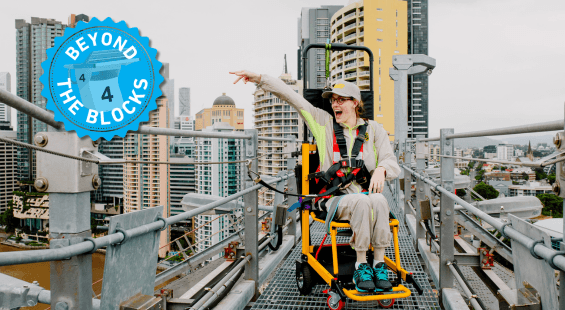
In this edition of Beyond the Blocks, world record holder, two-time Paralympic champion and Churchill Fellow Rachael Watson reveals her “responsibility” as a Brisbanite to shape Australian swimming and how her quest starts in the Northern Hemisphere.
Rachael Watson is determined to go where there is no path in order to pave her own
BRISBANE 2032 isn’t just a home Games for Rachael Watson – it’s a responsibility.
As a proud Brisbane local, Watson sees the Paralympic Games on home soil as a once-in-a-generation opportunity to shape the future of swimming in Australia.
Born a triplet, Watson has lived with autoimmune conditions for most of her life, but she never let that stop her from hitting milestones like learning to swim in her grandparents’ pool to completing a Bachelor and postgraduate degree and representing her country at three Paralympic Games.
At 21, Watson had to relearn how to swim after acquiring the rare neurological condition Guillain-Barré syndrome, which left her wheelchair-bound and living with ongoing pain and prone to spasticity.
Three years later, after finding both escape and purpose in the water, Watson became a Paralympic champion.
A stalwart of the Australian Dolphins Swim Team for more than a decade, Watson has been a dominant force in the S3 classification. She has broken barriers, collected medals and rewritten the record books.
At her first two Paralympic Games – Rio 2016 and Tokyo 2020 – Watson set back-to-back Paralympic records to claim the women’s 50m freestyle S4 title.
And then at the Paris 2024 Paralympics, she claimed bronze, becoming the first Australian to win a medal in a women’s 50m freestyle event at three consecutive Games (Paralympic and Olympic).
The 34-year-old also holds the world record in the women’s 50m freestyle S3.
With LA in her sights, Watson wants more. Not for herself, but for others.
Because for Watson, participation is education and education without opportunity is not inclusion.
“Even if only one person has looked up at me and thought ‘if she can do it, then so can I’ then that is enough. But I know it won’t stop there because the power of our community and the power of sport is inspiring in waves,” Watson said.
“My vision is to enable every person with a disability to either be water safe, learn-to-swim, swim recreationally for improved health or progress to a high-performance pathway to represent Australia at the Paralympics.
“And how can we do this, by investigating coaching methods and support requirements for swimmers with high support needs.”
This is where the prestigious Churchill Fellowship comes in, a research opportunity to study overseas in any field and to bring that knowledge back home.
It supports passionate individuals — not necessarily academics — to explore new ideas and bring home knowledge that drives social change.
Watson first learned about the Churchill Fellowship in Year 12 and as her swimming career flourished, so too did her vision: to close the gap in opportunity for the 5.5 million Australians living with disability, particularly those with high support needs, to be safe and comfortable in the water and, if they choose, to chase the green and gold.
“We, as a swimming nation, have a duty to help the next generation to be proud swimmers, no matter their ability,” Watson said.
“In the end, they don’t have to be Dolphins, they just have to be capable and confident in the water.”
As a Churchill Fellow, Watson will spend three months in Europe researching her project and at the centre of which is the power of coaches.
She has identified a gap in the number of coaches confident and equipped to work with para athletes, particularly those in lower classifications. Her approach starts at the foundation – shifting mindset.
“You don’t have to reinvent the wheel. If you’re a coach, you can coach anyone – apply the principles of swimming first, then make the necessary adjustments,” Watson said.
“My coach Matteo (Melis) is an inspiration behind this thinking. He had never coached a para athlete before me but that simply didn’t matter, now just look at how far we’ve come. I want to help provide the same opportunities that I had for others.”
Her vision is two-fold: to break down stigma and open coaches’ minds to the fact they can coach athletes with disability, and to provide Australians living with disability a clear and accessible pathway to begin their swimming journey.
Watson will spend much of her fellowship immersed within a high-performance squad in Monza, Italy, training alongside athletes with similar impairments and will also travel to Switzerland, Paris and Berlin to continue her research.
“Europe, especially Italy, has set a high standard for pathway development through to high performance for para athletes – particularly for those like myself in the lower classifications,” Watson said.
“I’m most excited about being immersed in their performance environment and learning from leaders in the space. Europe will be an incredible learning experience but when I’m back in Brisbane, that’s when the real work starts.”
For Watson, Brisbane 2032 is the north star but not the finish line.
Her goal is not simply to inspire coaches and athletes alike for one home Games, but to build a sustainable system that empowers athletes with high support needs for decades to come.
“If we want Brisbane to be our most successful Games, we need to fill every race with Aussies. But Brisbane is only six years away and athletes, especially lower-classed para athletes take time to develop,” she said.
“So, I’m more focused on how we can succeed beyond our home Games … because if we want a true legacy, we need to increase participation at levels and build an accessible pathway for all abilities.”
In time, Watson’s legacy won’t just be measured in medals but in the opportunities created.
Image credit: Story Bridge Adventure Climb
We hope you enjoyed this Beyond The Blocks read!
Dive into more Beyond The Blocks stories below:
Man of Molecular Motion: Meet the mastermind behind an innovative event that is making waves in the sport of open water swimming
(Featuring Dolphins Open Water Coach Fernando Possenti)
Detour of Duty: How Tom Gallagher became the first para swimmer accepted into the enclave of St Peters
(Featuring Tom Gallagher)
FIFO volunteer coach and mum becomes CEO of her swimming dreams
(Featuring Briana Crisp)
Grassroots to LA Dreaming: Regional teen queens Sienna Toohey and Mia Hogan have put on a clinic this year, putting their town of Albury on the 2028 green and gold runway
(Featuring Sienna Toohey & Mia Hogan)
Spinning a yarn has never been more powerful
(Featuring Grayson Doig)
The Little Club That Could: Explore the legacy of the famous Carlile Swimming Club
(Featuring Carlile Head Age Coach Michaela Pattinson)
Staying in Good Mick: A serendipitous plot twist delivers PB and possibly the greatest untold story of Nationals, until now
(Featuring Mick Schuddinh)
Keeping Time: How South Australia’s longest serving TO is keeping time for the spirit of club swimming
(Featuring Janine Molloy)
Full Throssell: Why this triple Olympian is flying business class and plunging into a whole new world of suits.
(Featuring Brianna Throssell)
Podium to Platform: Why an OAM means almost as much as Paralympic gold to world-record holder Tim Hodge
(Featuring Timothy Hodge)
Surf and Perf: How the black and gold inspired the green and gold
(Featuring Lani Pallister & Callum Simpson)
Going for Bigger than Gold: How a young open water swimmer is paving the way for the Sri Lankan community
(Featuring Tharusha Perera)
Buddy Brilliant: How learn-to-swim classes inspired an LA story
(Featuring Decan Budd)